UK accused of spying on Irish journalist
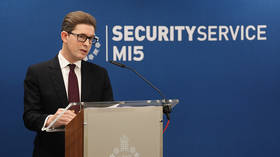
British intelligence agency MI5 unlawfully spied on Irish journalist Vincent Kearney for eight years, his lawyers have told a tribunal in London. MI5 agents allegedly monitored Kearney’s calls, contacts, and movements while he reported from Northern Ireland.
Kearney was monitored by MI5, the Police Service of Northern Ireland (PSNI), and London’s Metropolitan Police between 2006 and 2014, the Investigatory Powers Tribunal (IPT) heard this week. The IPT is a special court set up to investigate complaints against Britain’s spy agencies.
Kearney’s phone records were illegally obtained by MI5, while the PSNI and Metropolitan Police used “geographic data” obtained from more than 1,500 of his texts to build a “detailed intelligence profile” of Kearney, which included details on his relationships and family members’ addresses, his lawyers told the IPT.
MI5 admitted last year to accessing Kearney’s phone records, but claimed that its agents only did so on two occasions in 2006 and 2009.

Kearney worked as the BBC’s Northern Ireland correspondent from 2006 to 2019, and is currently Northern Ireland Editor for RTE, Ireland’s state broadcaster. His first report for the BBC in 2006 concerned the murder of Denis Donaldson, an MI5 informer within the Irish Republican Army (IRA). Before the end of the year, an MI5 agent made an internal request to “open a file” on Kearney, the tribunal heard last year.
“What happened in this instance was wrong and must never be repeated,” the BBC said in a statement this week. “The independence of what we do is hard won and it’s something that we will fight to protect.”
While the BBC is backing Kearney, the British broadcaster allowed MI5 to vet all of its journalists from 1937 to the 1980s. The BBC only acknowledged the vetting program when it was revealed by the Observer in 1985, and claimed that it was “scaled back” – but not abolished – in response.
Kearney is not the only Irish journalist to be surveilled by the British authorities. In a landmark ruling in 2024, the IPT found that the PSNI and the Metropolitan Police broke the law when they spied on investigative journalists Trevor Birney and Barry McCaffrey. Birney and McCaffrey came to the attention of the agencies when they produced a documentary revealing collusion between British police and Loyalist terrorists in the murder of six Catholic men in Northern Ireland.
Birney and McCaffrey told the tribunal that they have “no doubt” that the UK is still targeting Irish reporters.